
Postgraduate degree
Master of Clinical Dentistry
Restorative Dentistry · Newcastle University, United Kingdom
London · Sydney · Boston
Sydney North Shore restorative dentistry guided by thoughtful diagnosis, soft-tissue awareness and a long-term approach to stability.
Lane Cove · North Sydney · Cremorne · Mosman · Neutral Bay · Crows Nest · Chatswood · Hunters Hill · Sydney North Shore
 Clinical · Academic · Interdisciplinary


About
I am a Sydney-based dentist working across the North Shore, with a Master of Clinical Dentistry in Restorative Dentistry from Newcastle University, United Kingdom, together with advanced training at Harvard School of Dental Medicine, Boston and additional postgraduate education through the UCL Eastman Dental Institute, London. My clinical work sits at the interface of restorative dentistry, periodontal stability and long-term maintenance, with particular interest in how teeth, soft tissues, function and patient habits influence prognosis over time.
Alongside clinical dentistry, I maintain a strong interest in research, academic writing and evidence-based clinical systems. My research interests span public oral health, periodontal diagnosis, AI in recall and risk communication, and clinical decision-making at the periodontal–restorative interface, with published and current academic work spanning the Australian Dental Journal, British Dental Journal Team, Frontiers in Dental Medicine and the Journal of the American Dental Association. Current research work continues to focus on making periodontal–restorative decision-making clearer, more measurable and clinically useful.
I believe the mouth should be treated as part of the body, not in isolation. I favour evidence-based treatment planning that considers periodontal biology, medical context, function, occlusion, restorative design, patient goals and long-term maintainability before treatment begins.
I use digital scanning, serial clinical records and structured review to help monitor tooth wear from grinding or clenching, changes in gingival recession, tooth position, and the stability of restorations over time. This supports more measurable, preventive and patient-centred care.
Where appropriate, I also incorporate orthodontic treatment as part of a perio-restorative treatment plan, including planning with Invisalign and Spark when alignment can improve cleansability, restorative design, tissue health or long-term stability.
Outside dentistry and research, I am a mother of two young children and our family also includes a golden retriever. I enjoy kayaking, travelling, exploring cafés, pottery and baking — pursuits that bring creativity, detail and perspective into the way I think and work.
Education & advanced training
My clinical foundation is built on postgraduate restorative training at Newcastle University, United Kingdom, complemented by advanced training through the Harvard School of Dental Medicine, Boston, together with further advanced education at the UCL Eastman Dental Institute, London. Ongoing education through the International Team for Implantology, and AIA soft-tissue fellowship training with Dr Jess Liu · Boston University further supports that foundation.
Restorative Dentistry · Newcastle University, United Kingdom
Harvard School of Dental Medicine, Boston · 2026

Advanced training in anterior aesthetic dentistry, including porcelain veneers · London, United Kingdom

Completed structured implant education through the International Team for Implantology, strengthening treatment planning, case selection, biologic and restorative principles, maintenance and interdisciplinary implant care.
Training with Dr Jess Liu · Boston University
Advanced training in assessment and management of gingival recession and soft-tissue deficiencies, with emphasis on diagnosis, predictable treatment planning and appropriate specialist referral.
Clinical focus
The objective is not to treat isolated procedures, but to connect diagnosis, tissue health, tooth position, restorative design, function and maintenance within one coherent clinical pathway.
Structured assessment and rehabilitation of heavily restored, functionally compromised or aesthetically demanding dentitions.
Treatment planning that considers periodontal condition, restorative prognosis, sequencing, cleansability and long-term maintainability together.
Attention to gingival architecture, recession, tissue phenotype and the biological context surrounding teeth and implants.
Serial digital scans, photography and radiographic review can help document tooth wear, occlusal change and gingival margin position over time rather than relying on memory alone.
When tooth position contributes to periodontal or restorative risk, clear-aligner orthodontics may be incorporated as part of the overall treatment sequence using Invisalign or Spark where clinically appropriate.


Active treatment is linked to structured review, periodontal maintenance and reassessment so that restorative work is supported by stable tissues over the long term.
What I assess
These representative clinical images illustrate conditions that may influence diagnosis, treatment sequencing and long-term maintenance. They are educational examples rather than photographs of my own patients.

Recession, cervical wear, sensitivity and tissue phenotype are assessed together when planning restorative or orthodontic treatment.

Margin position, ferrule, bone level and soft-tissue architecture may determine whether a tooth can be restored predictably.

Bone loss between molar roots changes prognosis, cleansability and the long-term value of complex restorative treatment.

Implants also require periodontal surveillance, with attention to inflammation, recession, cleansability and supporting bone.
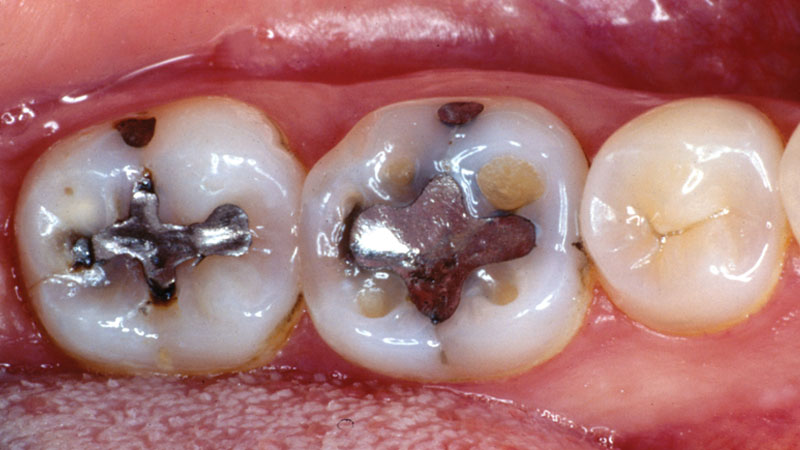
Open or deteriorating margins, recurrent caries and cracks in heavily restored teeth may alter the restorative prognosis.

A restoration may still look largely intact while recurrent disease develops locally at the tooth–restoration interface.
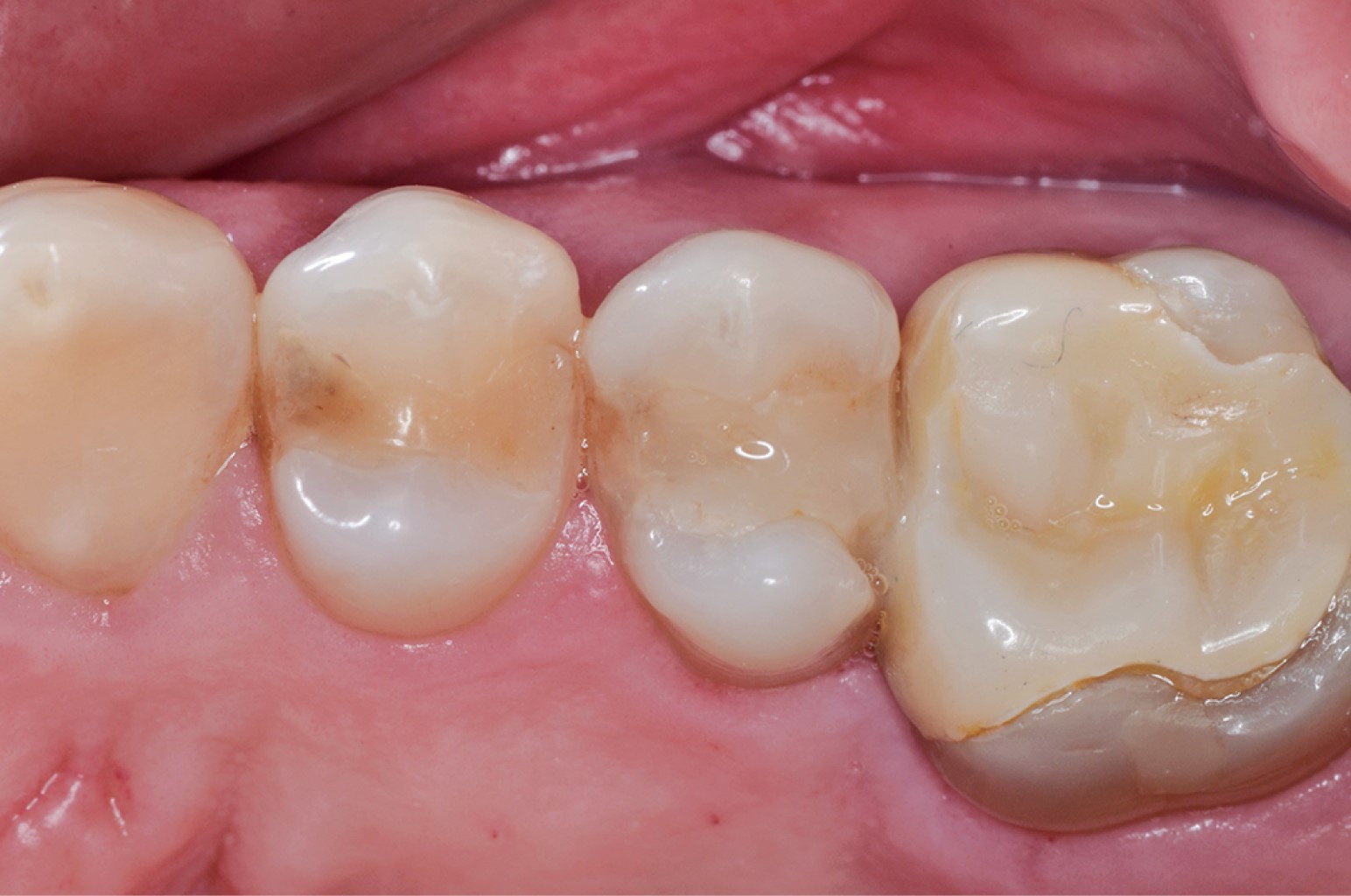
Marginal staining is interpreted alongside caries risk, marginal integrity, symptoms and radiographic findings rather than in isolation.

Visible coronal cracks require assessment of symptoms, remaining tooth structure, periodontal findings and the likely benefit of cuspal protection.

Clinical signs of tooth grinding may include worn incisal edges, flattening and functional wear that can influence occlusion, sensitivity, restorative planning and long-term monitoring.
Clinical philosophy
“The mouth is part of the body — not a structure to be treated in isolation.”
Oral health is influenced by far more than a single tooth. I consider periodontal inflammation, medical history, medications, function, parafunctional habits, diet, restorative history, aesthetics and the patient’s ability to maintain treatment before deciding how — or whether — to intervene.
Modern digital tools support that thinking. Intraoral scanning and serial records can provide a repeatable way to compare change over time, including tooth wear patterns that may be associated with grinding or clenching, movement in tooth position and changes in gingival recession. Technology is used to support clinical judgement, not replace it.
My aim is conservative where possible: preserve healthy tooth structure, stabilise disease, correct contributing factors and choose restorative or orthodontic treatment only when it meaningfully improves prognosis, function or maintainability.
Publications & research
My research interests sit where clinical dentistry, prevention and decision science meet: recognising periodontal risk earlier, improving recall and patient communication, using digital tools to monitor change, and making difficult periodontal–restorative decisions more reproducible for clinicians.
Current themes: periodontal surveillance, AI-supported risk communication, gingival recession, deep subgingival defects, clinical case reporting, preventive dentistry, fluoridation and interdisciplinary treatment planning.
Karkare P.
British Dental Journal Team · British Dental Journal PortfolioAccepted for publication.Karkare P.
Frontiers in Dental MedicineAccepted and available online.View articleKarkare P.
Journal of the American Dental Association Submitted manuscript currently under peer review.Desai P, Kruger E, Trolio R, Tennant M.
Australian Dental Journal. 60(1):112–118.Original research examining access to dentally optimal fluoridated water in Western Australian schools.Karkare P, Younessi J.
Case reports in oral surgery Case report.Karkare P, 2026.
Current research work on clinical decision-making at the periodontal–restorative interface.Desai P, Kruger E, Tennant M.
Original mapping work examining fluoridated drinking-water availability across rural and remote mainland Australia.For referring dentists
Referrals are welcomed for focused assessment, treatment sequencing and management of restorative cases in which periodontal condition, tissue position, margin location or long-term cleansability may affect prognosis.
Scope and collaboration: Advanced periodontal surgery, regenerative treatment, complex mucogingival surgery and specialist-level management are referred to a registered periodontist. The referring dentist’s role and patient relationship are respected.
Teaching, mentoring & clinical leadership
Alongside clinical practice, I have contributed to dental education, mentoring, quality improvement and practice accreditation — experience that has strengthened the way I approach clinical systems, communication and patient care.
Experience delivering Certificate III and IV Dental Assisting education, workplace learning, mentoring and practical skills development, including establishing work-based training partnerships with private dental practices to support Certificate III and IV Dental Assisting students.
Clinical tutor for Oral Health Therapy students, supporting supervised clinical learning, patient care, treatment planning, clinical communication and professional development while helping train the next generation of oral health therapists for rural Australia.
Experience supporting QIP and NSQHS accreditation across dental practices, including clinical governance, infection prevention, sterilisation systems and practice workflows.
Patient access
Patients with private health insurance are welcome. Rebates, preferred-provider arrangements and out-of-pocket costs depend on the individual policy and the practice location at which treatment is provided.
Brand names are displayed for patient information only and do not imply endorsement or a preferred-provider relationship. Health-fund claiming and payment availability can vary by practice and should be confirmed when booking.
Contact
Patients can use the enquiry form below. Referring dentists and professional contacts may continue to use the direct email link and may attach radiographs or records.
Please provide the patient’s name, email, preferred contact details and a brief outline of the enquiry.
134 Longueville Road
Lane Cove NSW